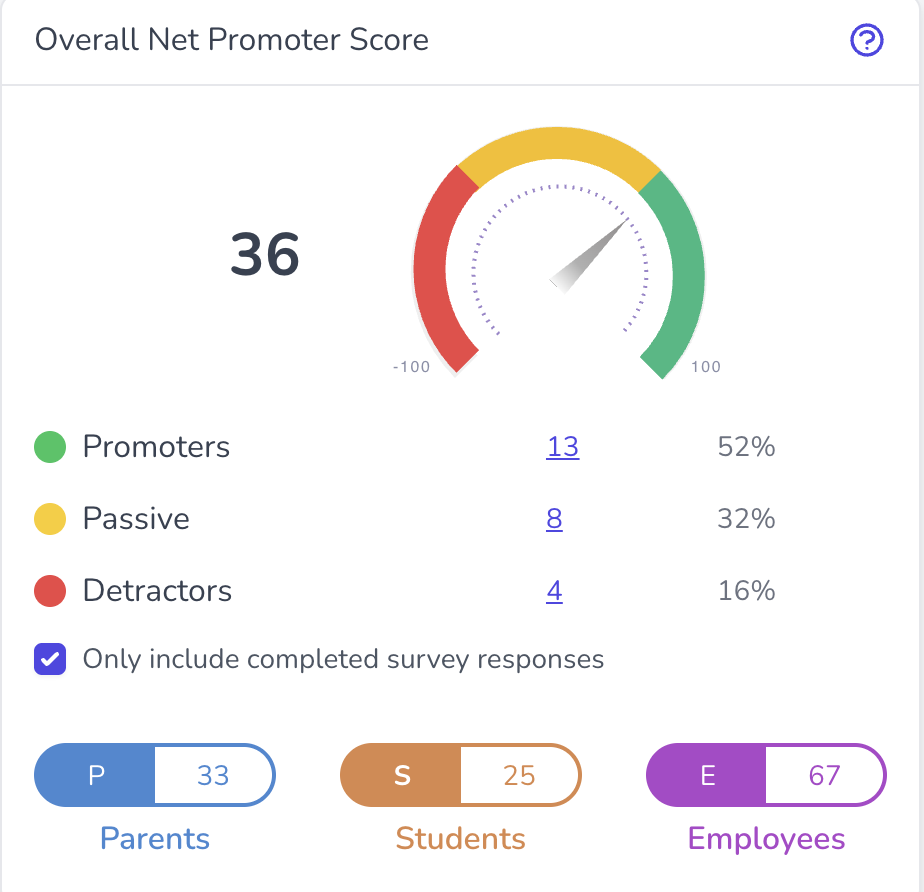
At ParentPulse, we place a strong emphasis on Net Promoter Score (NPS) because it’s a powerful indicator of organizational growth, satisfaction, and advocacy. NPS helps you understand how likely your school community is to recommend your school to others—and, importantly, how many people are actively serving as promoters for your school. Research has consistently shown a strong correlation between an organization’s growth and its proportion of promoters. In short, if you want your school to grow, you need a strong network of promoters advocating for you within your local community. One of the most important things to understand about NPS is its range: NPS runs from -100 to +100, not from 0 to 100. Respondents are grouped into three categories based on how likely they are to recommend your school:
Your Net Promoter Score is calculated by subtracting the percentage of detractors from the percentage of promoters: NPS = % Promoters – % Detractors For example, if every respondent were a detractor, your NPS would be -100. If every respondent were passive, your score would be 0. And if every respondent were a promoter, you would achieve a perfect 100. |
| What's a Good Net Promoter Score (NPS)? |
There are varying views on what qualifies as a "good" Net Promoter Score, and context matters. In general, a score above 0 means you have more promoters than detractors, which is a positive sign. However, schools are relationship-driven organizations with families and community members who have multiple interactions and touch points throughout the year. For organizations like these, a higher benchmark is appropriate. Bain & Co., the creator of the Net Promoter Score, suggests:
The average NPS among ParentPulse schools typically falls between 60 and 65. Rather than focusing only on reaching a particular benchmark, it’s also helpful to track your school's NPS over time. Changes in your score can reveal whether the experience you provide families is improving and whether you're building a stronger base of advocates.
|
| How to Improve Your NPS |
No matter where your score lies, there are always opportunities to boost it. Here are three actionable tips:
|
Additional Resources
Want to read more? Check out this blog post for more helpful context on the Net Promoter Score.
Was this article helpful?
That’s Great!
Thank you for your feedback
Sorry! We couldn't be helpful
Thank you for your feedback
Feedback sent
We appreciate your effort and will try to fix the article